
How Does IPTV Work? — Technical Architecture Explained
Read our expert walkthrough to master modern internet television, optimize your IPTV Testline, and unlock flawless 4K entertainment.
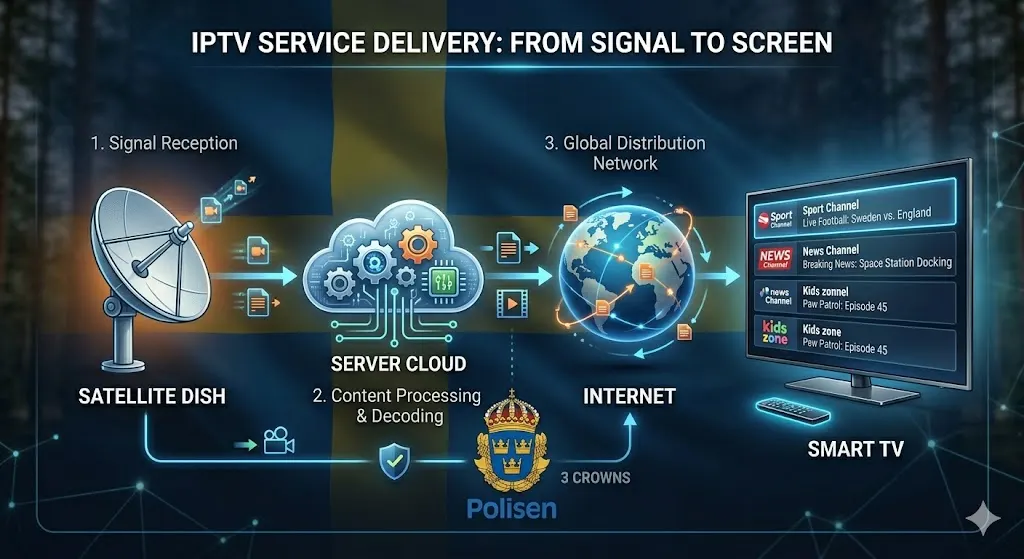
The Underlying Architecture of Digital TV Streaming
Behind every smooth television stream lies a sophisticated, high-speed delivery pipeline. Understanding how an IPTV Testline operates helps viewers appreciate why server infrastructure, network peering, and decoding hardware matter so much for a flawless viewing experience.
The 4 Stages of an IPTV Stream
- Content Ingestion & Capture: Live broadcast feeds are captured directly from master satellite transponders, studio fiber interconnects, and digital terrestrial transmitters.
- Encoding & Transcoding: Raw high-bitrate video feeds are compressed into efficient, streaming-friendly codecs—primarily H.264 (AVC) and H.265 (HEVC)—packaged into standard MPEG-TS or HLS (HTTP Live Streaming) transport streams.
- CDN Distribution & Load Balancing: Compressed stream segments are distributed across Content Delivery Network (CDN) edge nodes co-located near viewers (such as DE-CIX in Frankfurt), ensuring minimal latency and zero packet loss.
- Client Decoding: Your streaming player (such as TiviMate or IPTV Smarters) receives the digital packets and utilizes your television or streaming stick's graphics processor (GPU) to render smooth 4K 60fps video on your screen.
Why Server Quality Prevents Stream Freezing
Cheaper, low-grade providers overcrowd single servers with too many active viewers, leading to severe buffering during high-traffic events like football derbies. At testline iptv, we dynamically balance traffic across distributed 10 Gbps nodes, maintaining our verified 99.9% uptime standard.
Ready to Experience Premium IPTV?
Enjoy 40,000+ live channels in 4K, live Bundesliga coverage, and 120,000+ VOD movies with instant 5-minute activation on WhatsApp.
Order via WhatsApp 🟢